I. Introduction
Picture this: it’s 11:05 a.m., checkout chaos is in full swing, and your housekeeper is wrestling a wobbly cart that looks like it lost a fight with a stairwell. Linens tumble, shampoo bottles play hide-and-seek behind the toilet paper, and the lone trash bag is dangling like a surrender flag. Guests notice—always—and within minutes that 4-star review drops to 3 because “hallway looked messy.” A hotel housekeeping cart isn’t just a rolling closet; it’s the beating heart of your operation, the mobile command center that can make or break productivity, staff morale, and the all-important guest first impression.
In other words, choosing the right cart is the quietest, cheapest revenue-protection move you’ll make all year. This guide will walk you through a systematic, no-nonsense approach to picking a workhorse that matches your room count, budget, brand vibe, and the narrow turn into the service elevator that everyone insists is “standard size.”
II. User Search Intent Analysis
Who’s Googling “how to choose a hotel housekeeping cart” at 9:47 p.m. with a half-chewed pen and a procurement deadline? Usually three people:
- The Purchasing Manager who needs to shave 8 % off CapEx without triggering a union grievance.
- The Housekeeping Supervisor whose current carts have caster wheels that squeak like a horror-movie door.
- The General Manager who just toured a competitor’s spotless corridor and whispered, “Why can’t we do that?”
They all share the same pain points: carts that are too small, too flimsy, too hard to steer, or too ugly to park in front of guests. Their end goal is gloriously simple: buy once, cry once, and never again watch a housekeeper drag 40 lbs of towels down the hall because the cart won’t fit in the doorway.
III. Core Functional & Capacity Needs Assessment
3.1 Sizing & Tier Configuration
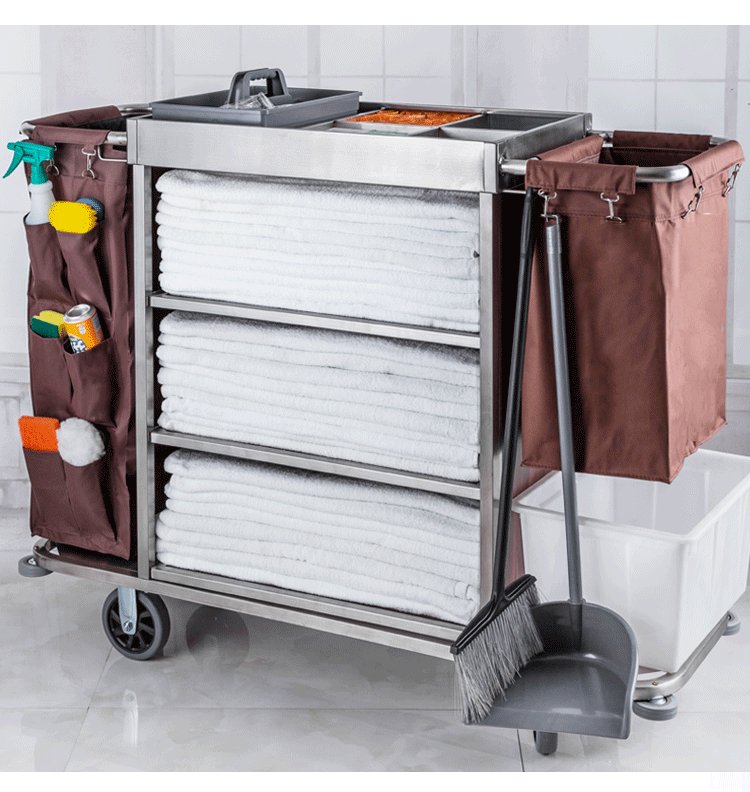
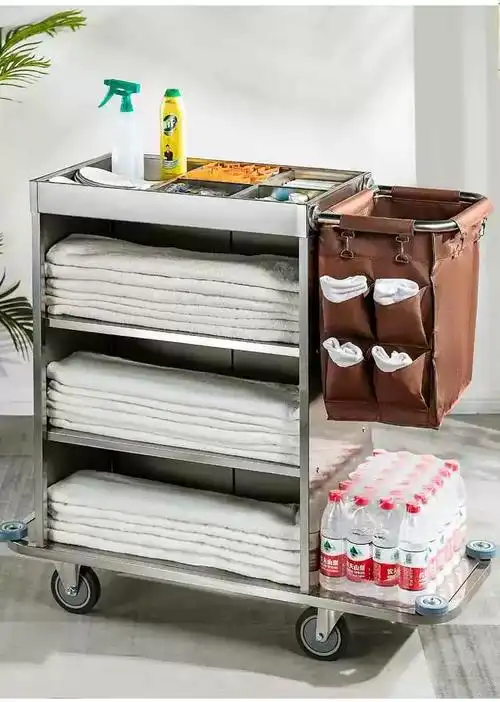
Think of cart tiers like hotel floors: more levels equal more rooms, but only if the elevator can handle it. A 120-room select-service property typically rocks a double-tier cart: top shelf for folded linens, bottom shelf for supplies, and a side bag for soiled laundry. Boutique properties with 40 keys and narrow hallways often prefer a single-tier “lean machine” that slips past guests without a “sorry, let me just… awkward shuffle.” Conference hotels running 300+ rooms may graduate to triple-tier giants or even double-sided units like the Aukron AB22 Iron-Wood cart—essentially the Swiss Army knife of linen logistics, giving you access from both sides so two housekeepers can stock simultaneously during a rush.
3.2 Storage Capacity Analysis
Do the napkin math: average stayover uses 3 towels, 1 bathmat, 2 sheets. Multiply by rooms per shift, add 15 % buffer for “can I get extra towels?” calls. Suddenly you need 72 towels, 24 sheets, and a par level of amenities that could stock a small pharmacy. Sketch a quick list:
- Linens: 2.5 cu ft per 10 sets
- Amenities: shoebox-sized tote = 50 tubes lotion + 40 soap bars
- Trash: 33-gallon vinyl bag holds ~25 lb of wet landfill doom
If your current cart can’t swallow those numbers in one load, you’re paying staff to walk back to the laundry room more often than a Fitbit addict.
3.3 Specialized Features & Accessories
Accessories are the avocado on the toast: skip them and it feels sad; overdo it and you can’t close the lid. Prioritize:
- Laundry bag frame—keeps soiled linens off the clean shelf (hygiene brownie points).
- Trash bag holder—swings out so housekeepers aren’t balancing coffee grounds on a pillowcase.
- Hanging rod—essential if you provide robes or pressed garments; nobody likes a creased lapel.
- Caddy slots—molded holsters for spray bottles prevent the “where’s the glass cleaner?” scavenger hunt.
The Aukron AB22, for example, ships with silent, non-marking wheels and a sturdy bracket for a removable laundry bag—details that turn a 30-minute room flip into a 22-minute victory lap.
IV. Structural Design & Material Selection
4.1 Frame Material Comparison
| Material | Pros | Cons |
|---|---|---|
| Stainless Steel | Rust-proof, MRI-level clean look, 15-year lifespan | Heavy, pricey, can dent if rammed into a marble column |
| Aluminum | 50 % lighter than steel, never rusts, easy to push uphill | Lower load capacity, bends under 400 lb of towels |
| Powder-Coated Steel | Budget-friendly, color options to match décor | Chips lead to rust; touch-up paint becomes your new hobby |
Upscale resorts where guests Instagram the hallway? Stainless sings. Limited-service hotel with tight CapEx? Powder-coated steel plus a strict “no ramming” policy works.
4.2 Shelf/Basket Material Options
- Metal wire mesh—open, breathable, linens don’t “sweat,” but small amenities fall through like jailbreakers.
- Solid plastic—easy to wipe, nothing escapes, yet water pools if housekeeping doesn’t squeegee.
- Canvas bags—lightweight, washable, but can absorb eau de chlorine over time.
Hybrid approach: wire shelves with removable plastic inserts give you flexibility and keep the auditor smiling.
4.3 Wheels & Mobility Systems
Ever tried steering a grocery cart with a wonky wheel? Multiply by 80 lb of linens and a 100-foot corridor. Specs that matter:
- 6-inch polyurethane swivel casters—glide over carpet, don’t mark marble, last 3–5 years.
- Two brakes minimum—engage when parking on sloped parkade ramps so the cart doesn’t ghost-ride into the valet stand.
- Load rating per wheel—look for 275 lb+ per caster if you run double-sided tanks.
V. Ergonomics & Operational Convenience
5.1 User-Friendly Design
Handle height should sit between hip and waist—roughly 36–40 inches for the average U.S. female housekeeper (Bureau of Labor Statistics puts the mean at 5’4″). A handle angled 15° reduces wrist strain the same way a good ergonomic mouse saves an office worker from carpal tunnel doom.
5.2 Logical Layout & Organization
Apply the grocery store rule: milk at the back, gum at the front. Clean linens go on the top tier (eye level), amenities in clear bins mid-ship, trash at the bottom rear so leaky bags don’t drip on fresh sheets. Color-coded totes stop cross-contamination—red for high-risk areas (bathrooms), blue for general areas. CDC guidelines for environmental infection control in healthcare facilities recommend similar zoning; hotels aren’t hospitals, but why not borrow best practice?
5.3 Maneuverability in Hotel Environments
Measure your narrowest doorway (usually the bathroom entry at 28 inches). Cart width must clear it with an inch to spare or you’ll be playing demolition derby with the doorframe. Turning radius under 50 inches lets staff pivot from corridor to elevator without a three-point turn worthy of a driver’s-ed fail video.
VI. Durability, Maintenance & Lifecycle
6.1 Structural Integrity & Load Capacity
Check the spec sheet for “maximum distributed load.” A 500 lb rating sounds beefy until you remember 50 bath towels already weigh 60 lb when dry—double when wet. Add 20 sheets, amenities, and the morning’s collection of half-used shampoo bottles and you’re flirting with 300 lb. Give yourself a 2× safety margin so the cart doesn’t sag like a middle-age mattress.
6.2 Corrosion & Chemical Resistance
Quaternary ammonium disinfectants and chlorine bleach munch metal for breakfast. Stainless 304 grade laughs at them; powder-coated steel needs routine wipe-downs and touch-up paint. Aluminum? It corrodes gracefully—white powder instead of orange rust—but still weakens over time.
6.3 Ease of Cleaning & Daily Maintenance
Smooth, rivet-free surfaces save labor minutes. Housekeepers should be able to run a disinfectant wipe across the cart in under 60 seconds. Removable laundry bags and tool-free caster bolts make nightly deep-cleans realistic instead of wishful thinking.
6.4 Repairability & Long-Term Costs
Ask suppliers: Are wheels, axles, and baskets available as spare parts? A $12 replacement caster beats buying a whole new $600 cart. Iron-wood hybrids like the Aukron AB22 pair replaceable hardwood panels with a steel frame—ding a corner? Swap the wood, not the entire end panel.
VII. Safety Features & Industry Compliance
7.1 Ergonomic Safety
OSHA’s push-pull guideline recommends forces under 50 lb initial, 40 lb sustained. Fully loaded carts above 350 lb can exceed that on carpet. Larger wheels or motor-assist add-ons keep you compliant and staff injury claims low.
7.2 Stability & Anti-Tip Design
Look for a wheelbase at least 75 % of cart height. Lower center of gravity (heavy items at bottom) and side-load guards prevent the “slow-motion tumble” that turns 200 sheets into hallway origami.
7.3 Guest & Property Protection
Rounded bumpers or vinyl corner guards cost about $4 each and save you $200 to re-paint a guest-room door. ROI in one near-miss.
7.4 Hygiene & Contamination Control
Enclosed vinyl laundry bags with drawstrings contain soiled linens and reduce airborne bacteria. A study in the American Journal of Infection Control found sealed containment cut colony-forming units by 55 % in hospital hallways—again, hotels can piggyback on healthcare wins.
VIII. Budget Considerations & Procurement Strategy
8.1 Price Range Analysis
Entry-level powder-coated carts start around $350. Mid-tier aluminum or hybrid runs $600–$800. Premium stainless double-sided models crest $1,200. The Aukron AB22 sits in the sweet spot near $850, marrying wood accents with commercial-grade steel—cheaper than full stainless, swankier than painted metal.
8.2 Total Cost of Ownership (TCO)
Spreadsheet time:
- Initial price: $800
- Annual maintenance (casters, touch-up): $40
- Expected life: 7 years
- Rescue value: $100 (metal scrap)
- TCO ≈ $740 over 7 years = $106 per year
Compare that to a $350 cart that folds after 30 months—TCO jumps to $140 per year. Penny-wise, pound-foolish.
8.3 Supplier Evaluation
Warranty: minimum 3 years on frame, 1 year on wheels. Ask for references from like-sized hotels. A supplier who can’t name three properties you can call is a red flag wearing a trench coat.
8.4 Avoiding Common Purchasing Pitfalls
- Price-only trap—finance high-fives you today, housekeeping curses you for 1,000 tomorrows.
- Overbuying bling—gold-plated carts still need to haul dirty socks.
- Ignoring hallway width—measure first, order second.
IX. Frequently Asked Questions (FAQ)
Q1: What is the standard size or most common type of housekeeping cart for a mid-size hotel?
A 28-inch-wide double-tier cart, roughly 50 inches tall, is the workhorse for 100–150 room properties.
Q2: Is stainless steel always the best choice?
Only if your brand aesthetic or corrosion risk demands it. Aluminum or powder-coated steel with proper care lasts 7+ years at lower cost.
Q3: How many rooms should one cart typically service per shift?
Industry average: 14–18 stayovers or 10–12 full departures, assuming a double-tier cart and 8-hour shift.
Q4: What are the most important features for staff comfort and efficiency?
Lightweight frame, ergonomic handle height, smooth casters, and clear shelf zoning to cut search time.
Q5: How often should housekeeping carts be replaced under normal use?
Expect 5–7 years for quality units, 3–4 for budget models. TCO calculations often justify the upgrade at year 5.
X. Conclusion & Final Checklist
Choosing a housekeeping cart isn’t rocket science—it’s tighter engineering with a splash of psychology. Get it right and you’ll shave minutes off every room, protect staff backs, and keep guests from Instagramming a hallway disaster. Before you click “purchase,” run this checklist:
- Capacity: Holds linens + amenities for your peak room-to-staff ratio
- Material: Stainless/aluminum for wet zones, powder-coated for budget, iron-wood for style points
- Wheels: 6-inch polyurethane, two brakes, 275 lb+ rating each
- Ergonomics: Handle 36–40 in, weight under 80 lb empty, smooth glide
- Safety: Rounded bumpers, anti-tip wheelbase, enclosed laundry bag
- Budget: TCO under $120/year, parts available, 3-year frame warranty
Tick every box and you’ll own a cart that works as hard as your team—and looks good doing it. Happy rolling!
XI. References & Further Reading
OSHA Manual Material Handling Guidelines
American Hotel & Lodging Association Safety Resources
CDC Environmental Infection Control Guidelines
Mayo Clinic Ergonomics Overview
Compendium of Physical Activities (used by health professionals for calorie expenditure data)