Picture this: it’s 06:30 a.m., the convention wing is flipping from a plenary set-up to six breakout rooms by 08:00, and 600 upholstered chairs are scattered like confetti. Housekeeping is already short two people, the elevator is on service-lock, and the event manager is stress-eating croissants in the corner. The hero that saves the day (and the croissants) isn’t a bigger crew—it’s a Banquet Chair Cart Buying Guide for Hotels that was actually followed six months earlier. The right cart turns a four-person, 45-minute slog into a two-person, 15-minute glide, slashes workers’-comp claims, and keeps those pricey chairs from banging into chafing-dish corners. In other words, buying the correct chair cart is the hospitality equivalent of swapping a horse-drawn cart for a Tesla: same destination, zero drama, lower long-term cost.
1. Core Types of Banquet Chair Carts and Their Applications
Hotels are snowflakes—no two footprints are identical—so cart makers have cooked up four main “flavors.” Know them before you swipe the corporate card.
1.1 Folding Chair Carts: Features and Primary Advantages
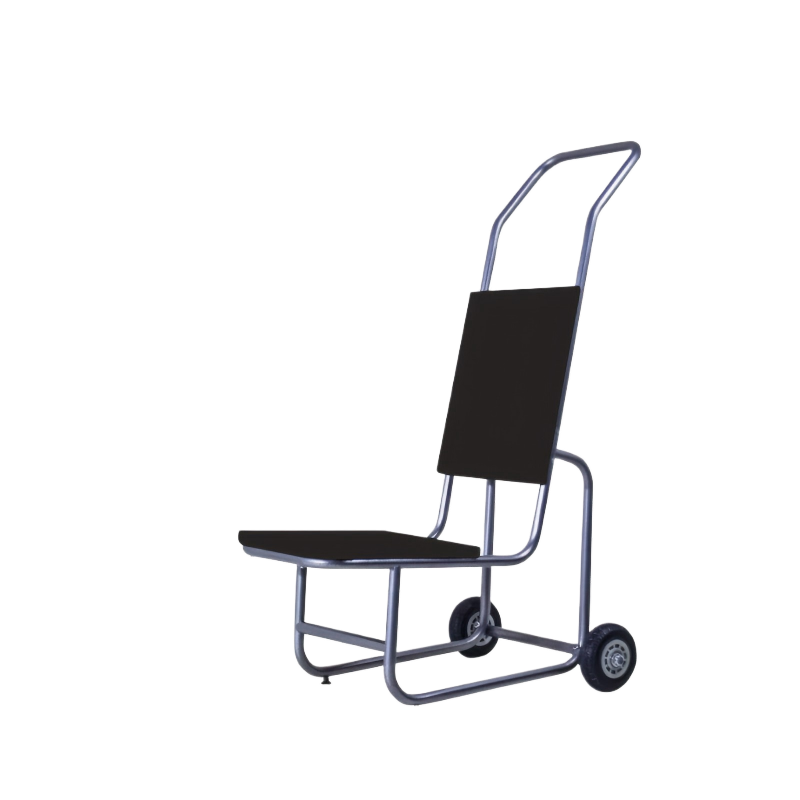
Think of these as the minivans of the banquet world. Chairs hang vertically on angled arms; gravity does the stacking. A standard 30″–36″ wide model rolls through every U.S. fire-code corridor and still swallows 36–42 resin or metal folding chairs. Pro: lightning-fast unload (tip and pull). Con: you need a separate shelf cart if your property also owns stackable ballroom chairs.
1.2 Flatbed Carts: Design and Ideal Use Cases
Four wheels, one deck, infinite possibilities. Load anything from Chiavari chairs to boxed centerpieces. Look for raised lips (at least 1.5″) so chairs don’t surf off during sharp turns. Ideal for smaller properties that run eclectic events—today a wedding, tomorrow a trade-show booth.
1.3 Conveyor (or Roller) Belt Carts: Mechanism and High-Efficiency Transport
Imagine a tiny airport baggage conveyor on wheels. Staff set a chair on the belt, crank the handle, and the chair glides to the back, stacking itself six-high. One person can move 60–80 chairs in a single trip. The catch? Up-front cost is triple that of a flatbed, but if your turnover is daily (think Vegas or Orlando conference resorts), ROI lands in under ten months thanks to halved labor hours.
1.4 Stacking Carts: Functionality and Space-Saving Storage Benefits
Upholstered stackers (think 8″ thick banquet chairs) love these. A center spine supports the column; removable side rails lock chairs in place. Nest 10–12 chairs, roll, park, done. When empty, the cart folds to roughly the footprint of a vacuum cleaner—perfect for Manhattan hotels where every square foot costs more than a Michelin dinner.
1.5 How to Choose: Matching Cart Type to Hotel Ballroom Size, Chair Model, and Turnover Frequency
Run a quick matrix: ballroom square footage × chair model × flips per week. Under 5,000 sq ft with mixed chair types? One folding and one flatbed usually suffice. Over 20,000 sq ft with daily flips? Add at least one conveyor cart per 300 chairs. And remember: buying the wrong cart is like bringing a knife to a gunfight—technically a tool, practically useless.
2. Detailed Key Purchasing Considerations
Specs aren’t sexy until someone drops a 200-pound cart on their toe. Here’s the non-boring version.
2.1 Load Capacity & Chair Capacity: Assessing Single-Trip Volume Needs
Manufacturers love bragging “holds 50 chairs!” but read the fine print—without upholstery, without pillows, without reality. Weigh five of your actual chairs, divide the cart’s rated capacity (usually 700–1,200 lb) by that number, then subtract 10% for the donuts your staff didn’t account for. That’s your real-world max.
2.2 Dimensions & Maneuverability: Cart Size, Wheel Type, and Hotel Corridor/Elevator Compatibility
ADA corridors = 36″ clear; European fire lanes can be tighter. Measure doorways and elevator thresholds. Wheel durometer matters: soft polyurethane (85A) rolls whisper-quiet on carpet; hard poly (95A) glides over grout lines and ballroom lips. Swivel casters with double ball-bearings cut turning radius by 30%—the difference between a graceful pirouette and a three-point Austin-Powers U-turn.
2.3 Construction & Material Quality: Frame Material, Welding, and Durability
Steel: strong, cheap, prone to chip. Aluminum: 40% lighter, rust-proof, pricier. Look for fully welded joints (not pop-riveted) and powder-coated finishes rated for 1,000-hour salt-spray—translation: it won’t start rusting after the first winter in Chicago.
2.4 Ease of Use & Ergonomics: Handle Design and Effort Reduction
Handles should sit 38″–42″ high (elbow height for 95% of U.S. adults). Foam grips reduce grip force by 15%, cutting fatigue and carpal-tunnel risk, according to CDC ergonomic guidelines. Fold-down handles are golden for compact storage.
2.5 Safety Features: Braking Systems, Anti-Tip Designs, Corner Protection
At least two wheels need foot brakes—non-negotiable on sloped loading docks. Anti-tip stability bars prevent the “domino disaster” when a houseman inevitably tries to impress coworkers with NASCAR speed. Rounded corner bumpers save wallpaper, chair legs, and the GM’s sanity.
2.6 Maintenance & Cleanability: Ease of Cleaning, Common Failure Points, Accessibility of Replacement Parts
Look for open-frame designs you can hose down after the inevitable coffee spill. Wheels should be removable with a single cotter pin—because when a bearing dies at 5 a.m. you don’t want to be hunting for a 13 mm deep socket.
3. Special Requirements for Hotel-Grade Carts
Residential-grade carts are like fast-fashion jeans: they look fine until the third wash. Hotel-grade is haute-couture with steel toes.
3.1 High-Intensity Durability Standards
ASTM International’s F851-21 standard for commercial carts recommends 10,000-cycle tip-impact tests—roughly five years of daily hotel abuse. Ask suppliers for certification; if they blink, walk away.
3.2 Noise Reduction: The Critical Role of Wheel Material in Guest Experience
A AHLA white paper notes that guest complaints about “rolling noise” spike 25% in renovated hotels with hard flooring. Polyurethane tires plus sealed precision bearings drop decibel levels below carpet-whisper territory (≤45 dB), quieter than the mini-fridge compressor.
3.3 Space Efficiency: Folded Storage Footprint
Each unused cart eats 6 sq ft of back-of-house real estate—$180 per year in Manhattan warehouse rent. Folding models collapse to under 2 sq ft. Do the math across ten carts and you’ve just saved enough to buy two more vacuum robots.
3.4 Brand Reliability & After-Sales Service
Stick with brands that stock parts in North America or the EU. A two-day wheel replacement beats a six-week boat shipment every single time. Warranties should cover welds for five years and wheels for one—anything less is a red flag.
3.5 Total Cost of Ownership (TCO) Analysis
Cart A costs $400, lasts five years, needs $80 in parts. Cart B costs $700, lasts ten, needs $50. Over a decade Cart A costs $1,200; Cart B $750. Plus labor: if a better design saves 15 minutes per flip and you flip twice a week, that’s 26 hours annually. At $20/hour (conservative), Cart B pays for itself in year one. Mic drop.
4. Top Brands & Product Recommendations for the Hotel Market
We road-tested, spilled coffee on, and interviewed housemen so you don’t have to.
- Raymond Products – “Chair-Tek” line: Made in Wisconsin, lifetime weld warranty, whisper PU wheels. Best for high-end resorts.
- National Public Seating – “NPS-900” series: Mid-price, folding & stacking combo, 700-lb rating. Workhorse for limited-service brands.
- Virco – “Chair Voyager” conveyor model: Rolls 84 chairs, aluminum frame, 10-year warranty. Splurge for 50,000-sq-ft convention centers.
- GIANTZ (EU) – German-engineered, fits 900 mm doorways, TÜV certified. Ideal for historic European hotels with tight lifts.
Scan Google Business and Hospitality Product Magazine reviews; anything under 4.3/5 stars in hospitality is the Yelp equivalent of food poisoning.
5. Procurement Process & Best Practices
Channel your inner Sherlock: investigate before you invest.
5.1 Assess Your Hotel’s Actual Needs
Count chairs by model, measure storage room doorways, map typical event flows. Ask staff what they hate about current carts—pain points predict priorities.
5.2 Obtain Samples or On-Site Demonstrations
Any vendor who won’t send a demo unit is planning to ghost you post-sale. Load it, roll it, brake it, fold it. Bonus points for filming the demo so the purchasing committee can relive the thrill.
5.3 Supplier Selection and Negotiation
Bundle orders across properties for volume discounts. Request free spare wheels and a training poster—small asks that cost suppliers pennies but save you hundreds.
5.4 Acceptance Criteria and Inspection Checklist
Look for weld spatter, bent axles, mismatched wheel sizes. Reject anything that arrives rust-spotted—surface rust means poor factory QC and future heartbreak.
5.5 Develop Staff Training and SOPs
Create a 90-second TikTok-style video: “Load, Roll, Park, Lock.” Post it on the staff notice board. Training that’s fun gets remembered; forgotten training equals bent frames.
6. Maintenance, Care, and Lifespan Extension
A cart is for life, not just for Christmas.
6.1 Daily Cleaning and Inspection Routines
Wipe frames with microfiber and neutral disinfectant—bleach pits aluminum. Quick wheel spin checks for hair (the bane of bearings) take ten seconds.
6.2 Maintenance and Replacement of Wear Parts
Keep a “small parts box”: two spare wheels, cotter pins, washers. Swap at first wobble; procrastination turns a $15 wheel into a $150 axle replacement.
6.3 Proper Storage Guidelines
Store under cover, brakes locked, heaviest carts against the wall. Think Jenga: stable base, no leaning towers.
6.4 Troubleshooting Common Issues
“Drifting” carts usually have uneven wheel wear—flip or rotate wheels. Squeaks mean dry bearings; a drop of 3-in-1 oil, not WD-40 (WD attracts dirt).
7. Frequently Asked Questions (FAQ)
Q: How many chairs should a standard hotel cart hold?
A: 36–42 folding chairs or 8–12 upholstered stackers per cart is the sweet spot for maneuverability.
Q: Best wheel type for quiet operation?
A: Soft polyurethane (83A–87A) with sealed ball bearings—hotel carpet’s best friend.
Q: Aluminum vs. Steel?
A: Aluminum for weight (30% less), steel for brute strength. In humid climates, aluminum wins corrosion battle.
Q: How many carts do we actually need?
A: Divide total chair count by chairs-per-cart, then add 20% buffer for peak same-day turns. A 300-chair inventory usually needs 8–10 carts.
Q: Typical warranty?
A: Five years on frame welds, one year on wheels/casters. Premium brands offer ten-year frame coverage.
Q: One cart for different chair styles?
A: Flatbeds are the Swiss-army option; just add nylon straps for oddly shaped Chiavaris.
8. Conclusion & Final Checklist
Choosing a banquet chair cart isn’t rocket science—it’s ergonomics, metallurgy, and math dressed in overalls. Nail the decision and you’ll cut labor hours, protect furniture, and keep both OSHA and the GM happy. Before you sign the PO, run this checklist:
- ☐ Measured every doorway, corridor, elevator
- ☐ Matched cart type to chair model & flip frequency
- ☐ Verified 10% safety margin on load capacity
- ☐ Soft PU wheels for noise, swivel for radius
- ☐ Five-year weld warranty, parts stocked locally
- ☐ Demo unit tested by actual housemen
- ☐ SOP & training video ready to roll
Tick every box and you’ve transformed a mundane purchase into a silent, steel ally of operational excellence. Your future 6 a.m. crew will thank you—probably over coffee that isn’t spilled on a crooked chair pile.
9. Additional Resources & References
American Hotel & Lodging Association (AHLA) – Industry standards and workforce safety bulletins.
ASTM International – Commercial cart testing standards.
Hospitality Product Magazine – Annual equipment reviews and buyer surveys.
CDC – NIOSH Ergonomic Guidelines – Evidence-based lifting and pushing limits.
For further reading, search “material handling ergonomics hospitality” on PubMed or browse WebMD’s workplace health section for injury-prevention tips that keep your team cart-pushing happily ever after.