The Role of Chair Transport Carts in Hotel Operations
Picture this: it’s 6:00 a.m. in a 400-room hotel, and tonight’s gala has to flip from “farm-to-table wedding” to “tech-conference general session” by noon. Somewhere between the coffee urns and the AV cables, a small army of banquet staff is sprinting through corridors stacked high with Chiavari chairs. One trip, one dropped stack, and the domino effect is real—scratched floors, bruised ankles, and a very unhappy bride on TikTok before lunch. That’s the daily reality the right banquet chair transport cart for hotels is designed to erase.
Efficient setup/breakdown isn’t just about looking slick; it’s about money. Labor is the single largest controllable cost in banquet operations, often chewing up 60–65 % of event budgets according to U.S. Bureau of Labor Statistics data. A cart that shaves ten minutes off every 100-chair move saves roughly one paid labor hour per function. Multiply that by 250 events a year and—voilà—you’ve just funded the coffee budget for the entire department (or, more responsibly, a nice bonus pool).
Understanding Banquet Chair Transport Carts: Basic Concepts & Importance
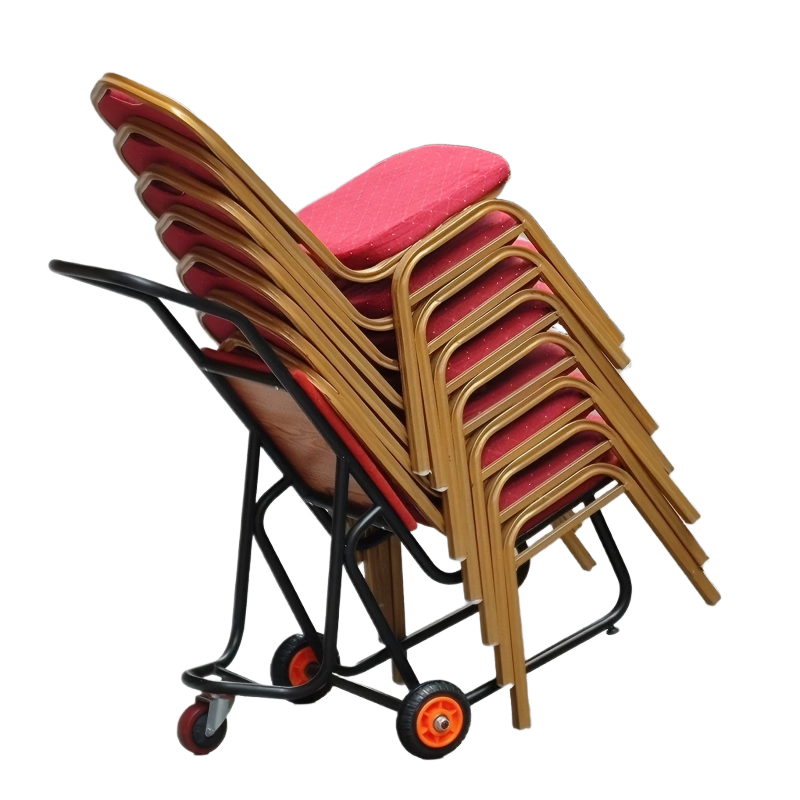
At its core, a banquet chair transport cart is a mobile frame engineered to hold, secure, and wheel stacks of chairs from storage to function room without turning staff into human forklifts. Think of it as a luggage trolley that went to hospitality school: same wheels, better manners.
Speed is obvious—one person can now move 30–40 chairs in a single trip versus 4–6 chairs by hand. Safety is subtler but sexier: fewer lifts mean fewer work-related musculoskeletal disorders, the leading category of hotel worker comp claims. And staff preservation? Happy banquet servers stick around, trimming the endless cycle of re-hire and re-train. Translation: your best people stay, and your HR manager stops stress-eating chocolate in the linen closet.
Key Factors to Consider When Choosing a Transport Cart
Buying a cart sounds simple until you’re staring at a spec sheet that reads like IKEA instructions translated by a physicist. Break it down:
Load capacity: Over-estimate. A stack of 30 resin Chiavaris can weigh 180 lb; the same number of wood ballroom chairs tips the scale at 300 lb. Choose a cart rated at least 20 % above your heaviest real-world load so you’re not the person who bent the axle on day one.
Dimensional compatibility: Measure chair height (floor to top of back), depth, and the footprint when stacked 8-high. Then add two inches clearance all around—trust me, chair legs have a rebellious streak at 2 a.m.
Construction material: Steel = brute strength, higher weight, possible rust if the powder-coat chips. Aluminum = lighter, rust-proof, pricier, and easier to maneuver but easier to dent if a forklift kisses it. Pick your poison based on climate (humid beach resort? Aluminum) and staff muscle mass.
Maneuverability: Look for 6-inch non-marking thermoplastic rubber (TPR) wheels: they roll over elevator thresholds like a Tesla over speed bumps. Ergonomic handle height should hit between waist and mid-chest; anything taller and you’ll jackhammer your shoulders, anything shorter and you’ll moonwalk.
Folding vs. fixed-frame: Folding carts collapse to roughly 18 in depth—perfect for Manhattan storerooms where square footage costs more than caviar. Fixed frames hold more weight and never pinch fingers but need a permanent parking spot. Choose folding if storage is tighter than skinny jeans after Thanksgiving.
Comparing Different Types of Chair Transport Carts: Pros and Cons
Standard platform carts: The Honda Civic of chair movers—cheap, reliable, boring in the best way. Pros: universal, fits most chairs, <$400. Cons: single level means multiple trips; you’ll still rack up steps.
Multi-tiered stacking carts: Think wedding cake on wheels. Two or three shelves let you segregate chair styles (white vs. mahogany) or move 60 chairs at once. Downside? Heavier, pricier, and you need 7 ft door clearance—bye-bye vintage ballroom archways.
Stair-climbing carts: Tri-star wheel clusters rotate like a tank tread, letting one person negotiate five steps to a mezzanine. Great for historic venues with no service lift. Bad for your wallet (think $1,200+) and useless on carpet; those little wheels sink like stilettos at a garden party.
Motorized assist: Battery-powered pushers turn the cart into an e-bike. Ideal for 1000-seat convention centers or resorts spread over 40 acres. Cost rivals a used Prius, and you’ll need an electrical outlet for charging—plan accordingly or push 600 lb manually when the battery dies mid-flip.
Budgeting and Cost-Benefit Analysis
Sticker shock is real, but so is math. A $650 heavy-duty cart that eliminates 15 labor hours per month (at $20/hour loaded cost) pays for itself in a hair over two months. Over five years, that’s a 1,400 % ROI—better than most crypto portfolios lately.
Total cost of ownership includes caster replacements ($25 a pop), annual bolt tightening, and the occasional powder-coat touch-up. Budget 8–10 % of purchase price per year; still pocket change compared to workers’ comp settlements that average $42,000 per injury claim.
Evaluating Safety and Ergonomics
Stability starts with a low center of gravity—look for decks that sit under 10 inches high. Side rails or telescoping posts prevent chair avalanches; OSHA loves anything that keeps objects “secured against movement.”
Ergonomic handles with foam grips reduce contact stress; angled at 15° keeps wrists neutral, sparing you the carpal-tunnel conversation. Never buy a cart without wheel locks on at least two casters—because physics doesn’t care about your timeline.
Sizing, Capacity, and Compatibility Testing
Grab a tape measure and your most common chair. Stack eight, measure height, add 4 in for the cart frame, then walk your route: doorways, elevator cab depth, ramp angles. If the cart + chairs is taller than the elevator handrail, you’ll be playing Jenga at 3 a.m.—fun only on YouTube, not in real life.
True on-site capacity is whatever number your weakest staff member can push up a 5° ramp. Test it during the demo; if the banquet intern can’t manage, the cart is too big no matter what the brochure claims.
Maintenance, Storage, and Maximizing Lifespan
Routine cleaning is simple: mild detergent, no pressure washer (it blasts grease out of wheel bearings). Hit casters with a silicone spray monthly; hair and lint love to ball up like tiny tumbleweeds. Inspect bolts quarterly—vibration loosens them faster than gossip spreads in the break room.
Store carts in a dry alcove, chained to a wall anchor so they don’t become bumper cars for the night crew. If space is premium, choose models with removable handles; you’ll fit four folding carts in the footprint of one fixed-frame beast.
The Step-by-Step Purchasing Decision Process
Step 1: Needs assessment. Count annual events, average chair quantities, and measure every choke point. Write it down—your future self will thank you.
Step 2: Research. Shortlist 3–4 suppliers. Read Google and industry forum reviews; ignore testimonials that sound like they were written by the vendor’s mother.
Step 3: Demo or trial. Any manufacturer confident in its welding will loan you a unit for a week. Run it through your nastiest carpet, steepest ramp, and crankiest union steward.
Step 4: Compare quotes. Look at line-item freight; a $50 cheaper cart that ships LTL from three states away can cost $200 more at your dock.
Step 5: Pull the trigger. Order two weeks before your busy season—lead times stretch when every hotel on the continent decides April is cart-buying month.
Recommended Resources and Product Examples
Reputable names include Raymond Products (made in USA, lifetime warranty on welds), National Public Seating (budget-friendly, wide dealer network), and MityLite (lightweight aluminum specialists). All carry BIFMA-certified models, meaning they’ve survived torture tests that would make a Navy SEAL cry.
For crowd-sourced feedback, check the International Association of Venue Managers forums or Reddit’s r/hospitality—the snark is free, but so is the wisdom.
Frequently Asked Questions (FAQ)
Q1: How many chairs should a good hotel transport cart hold?
A: 30–42 for standard resin or metal chairs; 20–28 for heavier wood. More than that and you’re into motorized territory.
Q2: Rubber or plastic wheels?
A: Non-marking TPR rubber wins on carpet and terrazzo; hard plastic is cheaper but squeaks like a mouse convention and can skid on polished concrete.
Q3: One cart for all chair styles?
A: Only if your chairs share similar seat heights and stacking buttons. Otherwise you’ll own the world’s most expensive frustration device.
Q4: Typical lifespan?
A: 8–10 years with basic maintenance; 5 if your crew uses carts as go-karts during graveyard shifts.
Q5: Replacement parts?
A: Most manufacturers sell casters, bolts, and handles online. Bookmark the parts page the day you purchase—future you is already busy.
Conclusion: Investing in Operational Excellence
Choosing the right banquet chair transport cart for hotels boils down to three non-negotiables: match the cart to your chairs, protect your people, and spend once for quality. Do that, and every flip becomes a choreographed dance instead of a slapstick scramble. Your staff clocks out on time, your floors stay Instagram-ready, and your accountant finally cracks a smile. In hospitality, the devil is in the details—but so is the profit. Roll wisely.