Picture this: it’s 6:00 a.m. in a Manhattan hotel, and a 400-person pharmaceutical breakfast is scheduled for 7:30. Somewhere in the bowels of the ballroom corridor, three bleary-eyed banquet porters are eyeing a mountain of 400 gold-padded chairs the way most of us eye a sink full of dishes after Thanksgiving—equal parts dread and caffeine. Now rewind the scene, swap in a banquet chair cart, and the same trio is done in 18 minutes flat, with time left to raid the pastry table. That, in a nutshell, is why the question “What is a banquet chair cart and why hotels need one” deserves a full, unabridged answer.
This article will define the cart, spotlight the very real (and expensive) pain points of manual chair wrangling, and explain why this un-sung hero of hospitality is less “nice-to-have” and more “how-did-we-ever-live-without-it.”
What Exactly Is a Banquet Chair Cart? (Definition and Basic Components)
A. Definition and Core Purpose
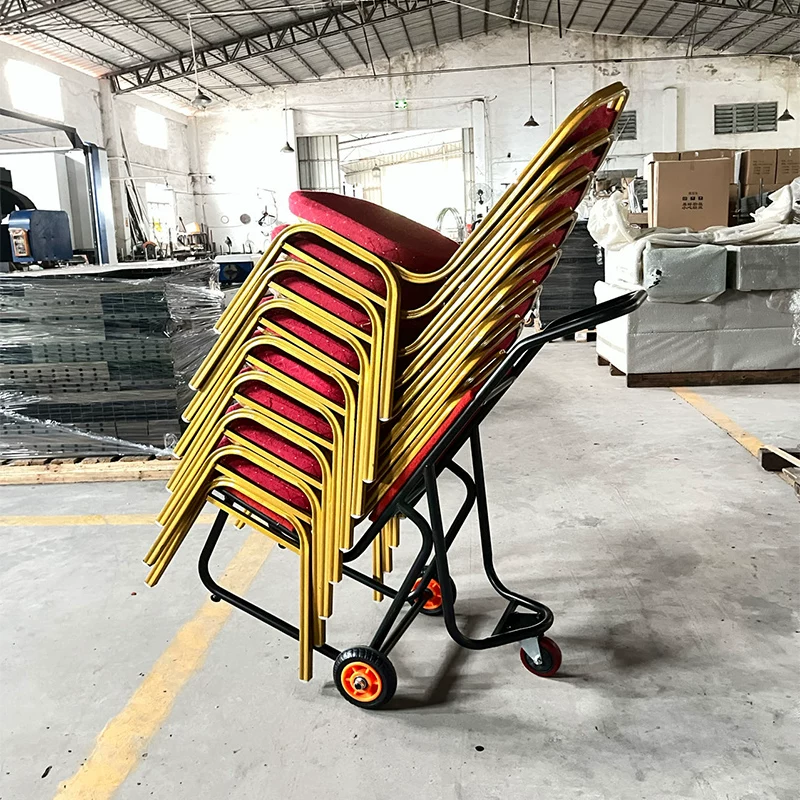
A banquet chair cart—sometimes called a chair truck, stack dolly, or “back-saver on wheels”—is a purpose-built trolley designed to move large quantities of banquet chairs in one neat, secure trip. Think of it as the Uber XL for chairs: everyone piles in at once, nobody gets left behind, and the driver (your staff) keeps both hands on the wheel instead of two fingers on a wobbling stack.
B. Key Components and Design Features
- Frame: Usually welded steel or aluminum, powder-coated to survive the inevitable elevator-wall love tap.
- Wheels: Two fixed, two swivel, often non-marking rubber. The best models pair a 4-inch center wheel with 5-inch corner casters so the cart can pirouette around ballroom pillars like a ballroom dancer herself.
- Handles: Dual-height grips let a 6’4″ linebacker and a 5’2″ supervisor push comfortably without kicking the frame.
- Loading Arms/Racks: Horizontal fingers or angled rails that slide between chair legs, cradling the stack so chairs don’t sway like Jenga blocks.
C. How It Works: Loading and Transporting Chairs
Staff tip the first six to eight chairs backward onto the loading arms, then wheel the cart forward so the next chairs “walk” themselves on. Once the stack reaches the safety stop, a strap clicks across, and off you go—no forklifts, no herniated discs, no chairs auditioning for a bowling-alley sound effect.
The Challenges of Manual Chair Handling in Hotels
A. Labor-Intensive Manual Carrying
Banquet chairs average 8–12 lb (3.5–5.5 kg) each. Multiply by 400 and you’re shifting two tons of furniture—by hand—before the coffee even kicks in.
B. Time Constraints in Event Setup/Takedown
According to STR’s 2023 Global Meeting Planner Survey, 68 % of corporate events have less than 60 minutes between room turns. That’s not a buffer; that’s a bullet.
C. Staff Fatigue, Strain, and Injury Risks
The U.S. Bureau of Labor Statistics lists “manual lifting of furniture” as a top-five cause of musculoskeletal injuries in the accommodations sector, averaging $32,000 per workers’ comp claim. One bad lift pays for a fleet of carts.
D. Potential Damage to Chairs and Floors
Dragging chair legs across terrazzo or engineered hardwood leaves scuffs that send the engineering team into CSI mode. Replacement glides and refinishing bills quietly nibble at the P&L.
E. Inefficiency in Large-Scale Operations
A single porter can carry two, maybe three chairs at once. A cart can move 36–42. That’s a 1,300 % efficiency gap—bigger than the difference between dial-up and fiber-optic Netflix.
Why Hotels Specifically Need Banquet Chair Carts (The Core Benefits)
A. Dramatically Increased Efficiency and Speed
The average cart reduces setup time by 55–70 %, according to internal time-motion studies shared by Hilton at the 2022 HFTP Annual Conference. Faster flips mean more revenue: the same room can host a breakfast, a lunch, and a wedding reception without feeling like a Formula 1 pit stop.
B. Significant Reduction in Labor Costs and Staff Strain
Fewer person-hours per turn translate directly to payroll savings. One Chicago hotel reported slicing overtime by 38 hours per week after investing in eight carts—an annual saving north of $65,000.
C. Enhanced Staff Safety and Reduced Injury Risk
OSHA’s ergonomics guidelines recommend keeping loads below 51 lb (23 kg) per person under ideal conditions. A 36-chair cart distributes roughly 360 lb, but the staff member only pushes, never lifts. Goodbye, lower-back claims; hello, safety bonus.
D. Protection of Chairs and Hotel Property
Chairs ride upright, locked by gravity and a strap, so upholstery doesn’t scrape, stack bars don’t bend, and walls remain scuff-free. Your CapEx budget quietly sighs with relief.
E. Improved Workflow and Event Turnaround Times
A smooth cart path from storage to ballroom is the hospitality equivalent of a Japanese train line: predictable, punctual, passenger (chair) satisfaction sky-high.
F. Empowering Staff and Boosting Morale
Nothing crushes team spirit faster than asking someone to sprint with furniture. Give them the right tool and you’ll hear fewer groans, more jokes, and maybe even a “let’s do this” high-five.
G. Professionalism and Operational Image
Clients peek behind the curtain more than you think. Watching staff glide carts in perfect formation whispers, “We’ve got our act together,” louder than any glossy sales brochure.
Key Considerations When Choosing a Banquet Chair Cart
A. Capacity
Most models handle 36–42 chairs. If your ballroom uses 550, do the math: you’ll need at least 14 carts to move the lot in one wave. Underestimating fleet size is the fastest way to turn a smart purchase into a half-solution.
B. Durability and Build Quality
Look for 12-gauge steel frames and wheels with sealed ball bearings. A cheap cart folds faster than a lawn chair at a tailgate; spend once, cry once.
C. Maneuverability and Ease of Use
Test-drive in your narrowest corridor. If you can parallel-park it between a stanchion and a fire extinguisher without a three-point turn, you’ve got a winner.
D. Compatibility with Hotel’s Chair Types
Chiavari chairs need different finger spacing than clamshells. Bring two chairs to the vendor showroom and insist on a live load demo—YouTube videos lie.
E. Storage Requirements
Nesting carts save 40 % floor space. Measure your storeroom aisle width; otherwise you’ll play Tetris every night at 1 a.m.
Real-World Applications in a Hotel Setting
A. Banquet Hall Setup and Breakdown
From 10-top rounds to theater-style rows, carts let crews pre-stage chairs in the service corridor, then roll them in like aircraft marshaled at a gate.
B. Conference Room Reconfigurations
A 200-person general session that flips to four 50-person breakouts in 30 minutes? Carts make the pivot possible without summoning every department plus the night janitor.
C. Outdoor Event Logistics
Rolling across pavers or grass is doable with pneumatic wheels; just swap casters seasonally. Your landscaping team will thank you for not dragging metal across Bermuda sod.
D. Storage Room Organization and Transport
Color-coded carts (red for ballroom, blue for boardroom) create a visual system so intuitive that even the new intern can’t mess it up—much.
Frequently Asked Questions (FAQ)
A. How many chairs can a typical cart hold?
Standard models carry 36–42; heavy-duty versions go up to 50. Always adhere to the manufacturer’s limit—gravity is a merciless auditor.
B. Are chair carts difficult to maneuver in tight spaces?
Not if you choose swivel casters and an overall length under 72 inches. Think of steering a shopping cart—only this one doesn’t veer toward the candy aisle.
C. Can one cart handle different styles of banquet chairs?
Many carts are adjustable, but extremes (Chiavari vs. oversized executive) may need separate models. When in doubt, bring donuts to the supplier and test everything.
D. What is the typical return on investment (ROI) for a hotel?
With labor saved, injury claims avoided, and overtime slashed, most properties break even in 3–6 months. One Boston property calculated payback in 38 days—faster than a celebrity marriage.
E. How do I train my staff to use them safely and effectively?
Start with a five-minute demo: load, strap, push, park. Post a laminated one-pager in the storeroom. Reinforce during pre-shift huddles. Mastery takes about as long as learning to swipe a key card—minus the accidental 2 a.m. lockouts.
Conclusion
A banquet chair cart is a steel-framed, wheeled concierge for your chairs—delivering them swiftly, safely, and scuff-free to any corner of the property. It eliminates the grunt work, shrinks labor costs, and turns event flips from sweaty chaos into choreographed calm. In an industry where the next client is already tapping their watch, that’s not just convenience; it’s competitive edge. So invest in the carts, protect your people, pamper your floors, and watch your ballroom morph from bottleneck to profit center faster than you can say “chairs up.”
References & Further Reading
OSHA Ergonomics Guidelines for Material Handling
U.S. Bureau of Labor Statistics – Accommodation Industry Injury Data
STR Global Meeting Planner Survey 2023
Hilton Worldwide – Internal Time-Motion Study, HFTP 2022
Mayo Clinic – Preventing Back Injury at Work
For product-specific specs and trial programs, consult reputable suppliers such as MityLite, National Public Seating, or your local hospitality equipment distributor.