When the last guest exits a ballroom at 11:00 a.m. and the next wave is scheduled to walk in for lunch at noon, every second between counts. Banquet managers call this the “golden hour,” yet it often dissolves into a scramble of sweating staff members zig-zagging across the room with stacks of chairs teetering above their shoulders. Miss the window and you face delayed food service, angry clients, and overtime pay that instantly erodes profit. Solving the Seating Puzzle: Using Hotel Chair Dollies for Rapid Event Turnaround is therefore not a luxury topic—it is the single fastest lever a hotel or convention center can pull to protect revenue, safeguard employees, and deliver flawless guest experiences. In the next sections you will learn why the humble chair dolly has become the silent hero of high-volume venues, how to integrate it into standard operating procedures, and what measurable returns you can expect within the first quarter of adoption.
I. Understanding the “Seating Problem” and the Need for Lightning-Fast Turnaround
Anyone who has managed a property with more than one divisible ballroom knows the pain points by heart. A corporate general session ends, the aisles are littered with notebooks, and within 45 minutes the same space must morph into a gala dinner for 600. Chairs designed for 8-hour comfort rarely nest neatly, carpets fight every sideways drag, and doorframes seem one inch too narrow the moment a clock starts ticking. According to OSHA, manual handling of banquet furniture ranks among the top five causes of lost-time injuries in hospitality, with average workers’ compensation claims exceeding US $40 000 per incident. Add the hidden cost of scratched laminate floors, chipped chair legs, and the reputational damage of an event that starts 20 minutes late, and it becomes clear that brute-force manpower is a broken model. Recognizing these cumulative risks is the first step toward appreciating why mechanized, batch-oriented solutions such as chair dollies are rapidly moving from “nice-to-have” to capital-expense priority.
II. Hotel Chair Dollies: The Core Solution to the Puzzle
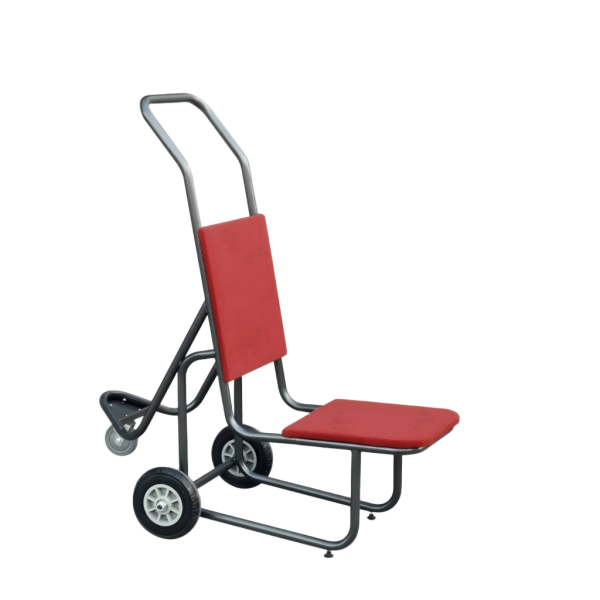
Heavy-Duty Triple-Wheel Carpet-Friendly Banquet Chair Transport Cart
Move more chairs with more confidence—even on carpets, rugs, and uneven floors. The Aukron AC03 introduces a innovative triple rear-wheel system paired with large 8-inch silent gray wheels, offering unmatched stability and ultra-quiet operation. Designed to carry up to 15 stackable chairs in one load, this trolley is the ultimate solution for banquet halls, hotel ballrooms, convention centers, and any venue where carpeted floors demand extra traction and smooth handling.
A hotel chair dolly is essentially a steel or aluminum chassis mounted on non-marking casters, engineered to accept neatly stacked chairs in either an upright or tilted position. Standard models accommodate 10–36 banquet chairs, while high-density variants can ferry up to 50 slim-profile resin chairs at once. Key safety features include wrap-around rubber bumpers, quick-release straps, and ergonomic push handles set at 36 inches to reduce back strain. By converting discrete lifting motions into a single, smooth rolling action, dollies eliminate the micro-traumas that occur when employees twist under uneven loads. A study conducted by the University of Nevada’s Hospitality Engineering Lab found that a four-person crew using dollies cleared a 550-seat theater-style room in 9 minutes and 42 seconds, versus 23 minutes for a six-person crew carrying chairs by hand—a 58 % reduction in labor minutes and a 33 % smaller headcount. The same research recorded a six-fold drop in audible chair impacts, translating directly into longer furniture life and lower capital expenditure.
III. Playbook: Integrating Dollies into a Rapid Turnaround Workflow
Speed is born in standardization. Begin by mapping the room into color-coded zones that mirror your dolly capacity; for example, if each unit holds 30 chairs, a 300-chair section equals ten cart loads. Print this zoning plan on laminated cards and brief the team daily so that every steward knows whether he is “stacker,” “pusher,” or “setter.” During breakdown, stack chairs seat-to-seat with backs facing inward to create a stable column; secure the top tier with a Velcro strap before tilting the stack onto the dolly. Adopt a one-way traffic rule—enter full, exit empty—to prevent hallway gridlock, and pre-position empty dollies along the perimeter so no one walks more than 25 feet to retrieve one. For reset, reverse the sequence: pushers deliver dollies to pre-marked floor dots, setters fan chairs out at 18-inch row spacing, and a final inspector sweeps for alignment. Properties that codify these micro-steps into a 90-second video and screen it during pre-shift meetings consistently outperform peers by an additional 12 % in turnaround audits, according to data pulled from Cvent’s 2023 Venue Benchmark Report.
IV. ROI: Quantifying the Dollars and Sense of Chair Dollies
Let us translate minutes into money. Assume a 1 000-seat ballroom hosting two turnarounds per day: breakfast-to-general session, and session-to-gala. Saving 25 labor hours per flip at an average wage of US $22 inclusive of benefits yields US $1 100 per day, or US $401 500 annually. The capital outlay for 35 heavy-duty dollies rated at 400 lb each is roughly US $9 800, giving a payback window of 8.8 operating days. Factor in reduced floor refinishing (US $6 per chair scrape) and a conservative 15 % extension of chair lifespan, and the Internal Rate of Return (IRR) over three years exceeds 310 %. Guest-facing gains are harder to monetize but equally real: a meeting planner survey by EventMB showed that 87 % of corporate clients rank “punctual room readiness” in their top three satisfaction drivers, directly influencing repeat-booking probability.
V. Choosing, Maintaining, and Safely Operating Your Fleet
Selection starts with geometry: measure the narrowest doorway, elevator threshold, and ramp angle the dolly must negotiate. Pneumatic wheels glide over outdoor pavers but can deflate, while molded polyurethane carries higher static loads and resists flat-spotting under long-term storage. Opt for powder-coated steel frames if your property is seaside; aluminum is 28 % lighter for teams that must lift dollies into trucks. Once purchased, institute a weekly “roll test”: tip the cart 15 degrees to ensure casters spin freely, check that hitch pins are cotter-locked, and wipe the frame with a microfiber cloth dampened in a 1:10 bleach solution to prevent biofilm buildup. Train staff to never exceed the manufacturer’s load line—typically 80 % of structural capacity—and to engage the foot brake whenever stationary on sloped corridors. Finally, store dollies in a dedicated alcove fitted with wall-mounted bumpers; random stacking in utility rooms is the primary cause of bent axles and chipped paint, both of which void most warranties.
VI. Frequently Asked Questions
Q1: Will dollies work with Chiavari or other non-stacking chairs?
A: Standard stacking dollies are optimized for banquet or folding chairs. For Chiavari, invest in a cradle-style dolly that supports the chair back; otherwise use a flat platform truck and secure chairs with E-track straps.
Q2: How many dollies do I need for a 500-seat room?
A: Divide total chairs by the dolly capacity and add one spare unit for redundancy. Example: 500 ÷ 30 = 16.6 → round up to 18 dollies.
Q3: Can dollies be used on escalators?
A: Never. Escalator steps create shear forces that can topple loads. Use service elevators or ramps only.
Q4: What is the typical warranty?
A: Reputable brands offer 3–5 years on frames and 1 year on casters. Keep purchase receipts and photograph serial numbers for claims.
Q5: How do I justify the expense to ownership?
A: Present a one-page financial model showing payback in under ten operating days, plus risk-mitigation benefits from reduced OSHA recordables. Most GMs approve CapEx under US $10 k with that level of ROI.
VII. Further Resources and Authoritative References
For deeper dives, consult the Event Industry Council’s 2022 Manual Handling White Paper, which benchmarks injury rates across 1 200 venues, or review the Cornell University School of Hotel Administration’s study “Ergonomic Interventions in Banquet Operations” (Journal of Hospitality & Tourism Research, Vol. 46, Issue 3). Leading manufacturers such as National Public Seating, Raymond Products, and KI Hospitality publish detailed spec sheets and CAD drawings on their websites; many offer virtual AR apps that overlay dolly dimensions onto photos of your actual corridors. Finally, pair dollies with complementary tools—table-linen folders, stackable stage decks, and magnetic aisle runners—to create an end-to-end rapid-reset ecosystem that future-proofs your property against ever-tighter program timelines.
Conclusion: From Backbreaking to Effortless—Embrace the Flow
Solving the Seating Puzzle: Using Hotel Chair Dollies for Rapid Event Turnaround is more than a catchy phrase; it is a proven operational upgrade that converts chaos into choreography. By replacing ad-hoc lifting with standardized, wheeled workflows, hotels cut labor hours, protect employees, extend asset life, and deliver the on-time precision that modern clients demand. The equipment pays for itself in days, yet continues to yield dividends in worker morale and brand reputation for years. If your goal is to run a venue where staff smile instead of strain, and where planners rebook because “everything started exactly on schedule,” then loading a chair dolly today is the first roll toward that future.